Chung Chieh(揭仲) provided an example, stating that the P&A data is equivalent to a quotation submitted by potential vendors, while the LOA draft is the contract draft during formal negotiations between the two parties. Both sides can negotiate the items, amounts, and payment milestones in the LOA draft before finalizing and signing it. Once the LOA is signed, the U.S. government will represent the purchasing country in subsequent processes such as vendor selection, negotiation, production, and delivery.
The advantage of this system is that the U.S. government will execute project management for the purchasing country; however, the downside is that it excludes certain clauses found in general commercial contracts, such as dispute resolution and arbitration mechanisms, primarily to facilitate the operations of U.S. administrative departments.
He noted that prior to Tsai Ing-wen’s administration, the U.S. insisted that Taiwan’s military procurement procedures must begin with a request for P&A. If the U.S. agreed to provide P&A, it would signify interdepartmental review and consent to sell. Taiwan would then plan its budget and apply for the LOR for LOA based on the P&A. However, since 2016, the U.S. has allowed Taiwan to skip the P&A stage and directly apply for the LOA draft when necessary.
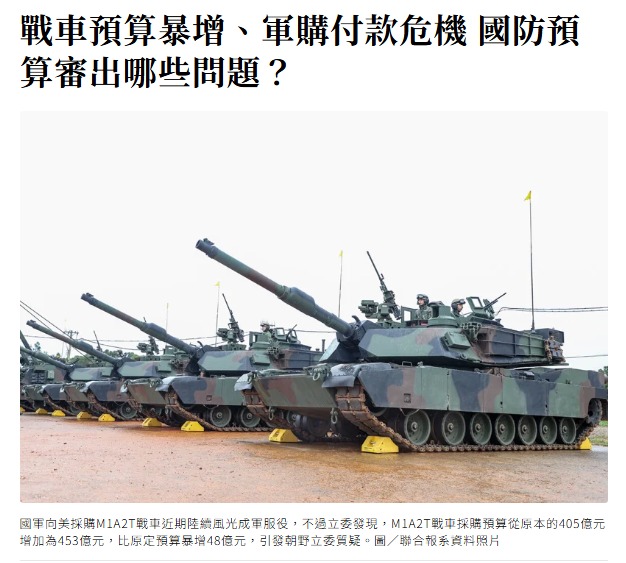
He interpreted that the M1A2T budget exceeding nearly 5 billion NTD is due to the Army’s procurement process for the M1A2T, which aimed to expedite the project by skipping the LOR for P&A stage and relying on price data previously presented in a military exchange meeting. This approach overlooked significant price fluctuations over the years without obtaining a formal quotation, resulting in an underestimated budget. (圖片擷取自聯合報數位版)
/https://vip.udn.com/vip/story/121160/9544803?from=vipudn_maincate_main2
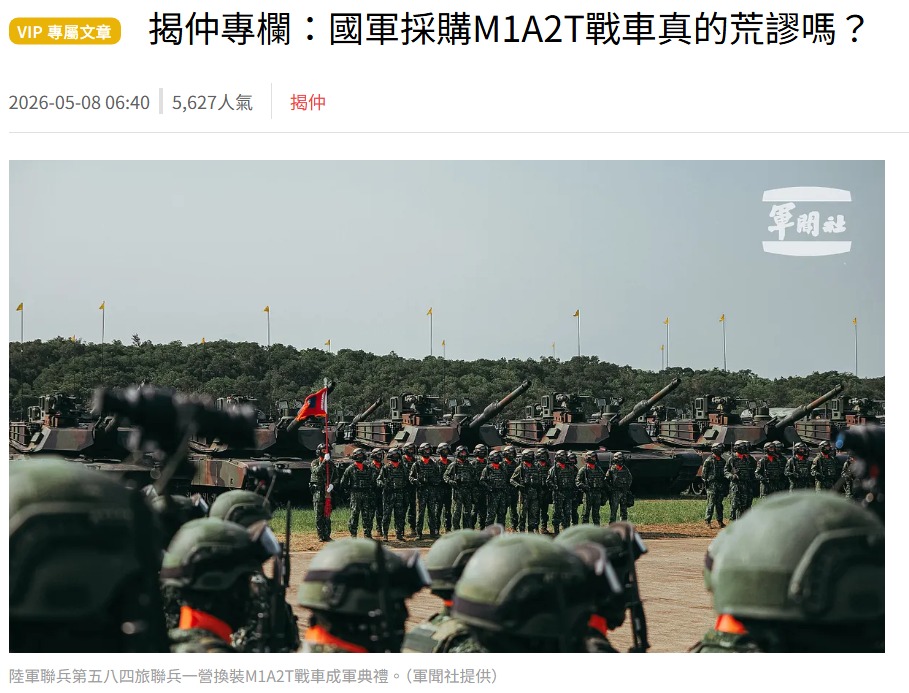
台灣多數橋樑無法通行M1A2T戰車,影響沒有想像中嚴重!只要戰車部隊各級指揮官,甚至各車的車長與駕駛,在承平時期做好戰場經營,切實掌握防區內橋樑與道路的狀況,規劃數條從營區開往戰力保存區,及從戰力保存區進入戰術位置時的機動路線,就可迎刃而解。就算前往戰術位置的機動路線上,真的無合適橋樑可用,或既有橋樑遭破壞,只要事先做好準備,還是能藉良好的計畫作為,運用工程手段或工兵裝備來克服。
在國軍從事的是國土防衛作戰,部隊早就「先處戰地」的情況下,單憑橋樑承重、地形破碎、高耗油甚至不適合城鎮地型等理由,就認定M1A2T戰車無用武之地,確實有「以偏概全」的情形;因為這些顧慮,都可透過平日的戰場經營來化解,絕非「不可承受之重」!
國人也該認清,在現代的戰場條件下,主力戰車雖已不再具備「陸戰霸王」的主宰地位,但因為主力戰車能兼顧火力、機動力與防護力,使其在現代的兵種聯合作戰中,仍將扮演重要的腳色。試問,若僅因為無人機對戰甲車所造成的威脅日益升高,就將戰甲車棄之不用;屆時步兵就必須自己扛著裝備與物資,靠雙腿機動,然後在敵軍的旺盛火力下,僅憑血肉之軀,對敵軍的設防陣地與障礙物發起攻擊,這顯然不切實際。(圖片擷取自風傳媒網頁)


近期迴響