Chung Chieh(揭仲) provided an example, stating that the P&A data is equivalent to a quotation submitted by potential vendors, while the LOA draft is the contract draft during formal negotiations between the two parties. Both sides can negotiate the items, amounts, and payment milestones in the LOA draft before finalizing and signing it. Once the LOA is signed, the U.S. government will represent the purchasing country in subsequent processes such as vendor selection, negotiation, production, and delivery.
The advantage of this system is that the U.S. government will execute project management for the purchasing country; however, the downside is that it excludes certain clauses found in general commercial contracts, such as dispute resolution and arbitration mechanisms, primarily to facilitate the operations of U.S. administrative departments.
He noted that prior to Tsai Ing-wen’s administration, the U.S. insisted that Taiwan’s military procurement procedures must begin with a request for P&A. If the U.S. agreed to provide P&A, it would signify interdepartmental review and consent to sell. Taiwan would then plan its budget and apply for the LOR for LOA based on the P&A. However, since 2016, the U.S. has allowed Taiwan to skip the P&A stage and directly apply for the LOA draft when necessary.
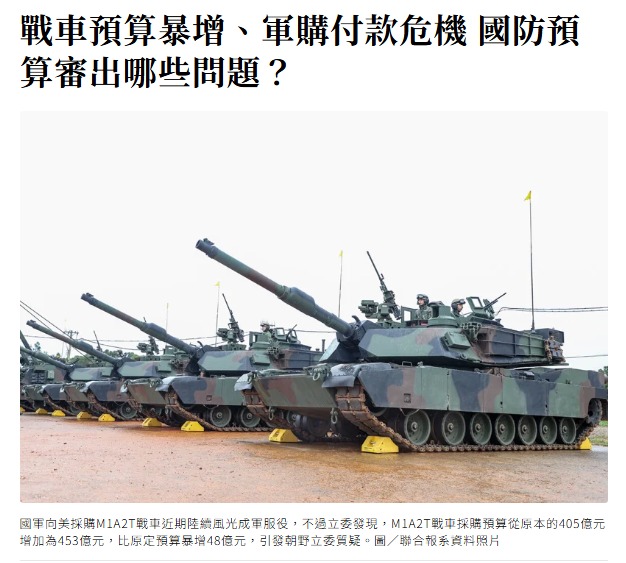
He interpreted that the M1A2T budget exceeding nearly 5 billion NTD is due to the Army’s procurement process for the M1A2T, which aimed to expedite the project by skipping the LOR for P&A stage and relying on price data previously presented in a military exchange meeting. This approach overlooked significant price fluctuations over the years without obtaining a formal quotation, resulting in an underestimated budget. (圖片擷取自聯合報數位版)
/https://vip.udn.com/vip/story/121160/9544803?from=vipudn_maincate_main2


發表留言