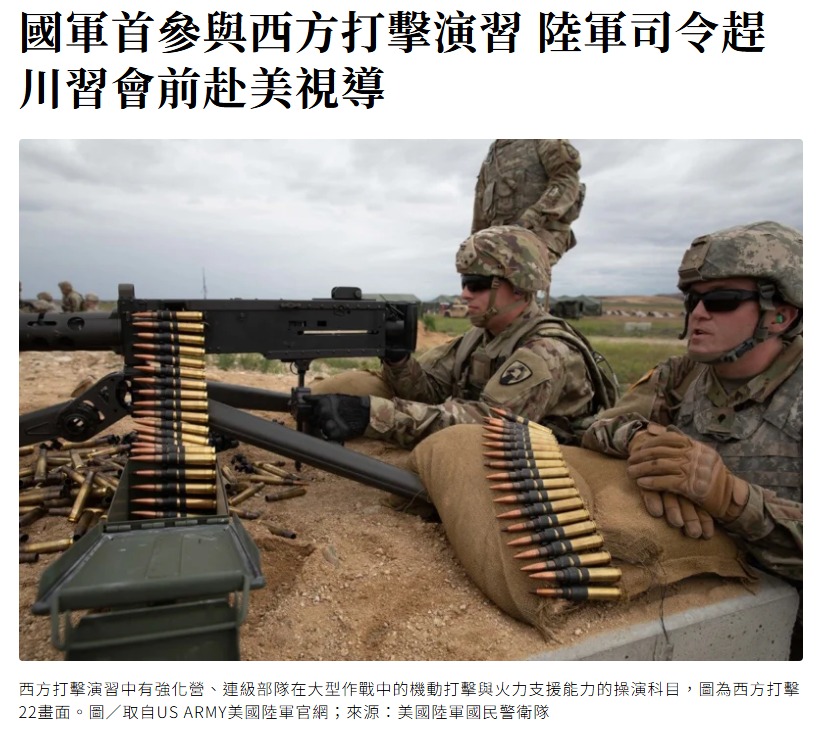
Chung Chieh(揭仲) stated that the backbone of the Taiwanese military’s artillery in the future will consist of 111 M142 High Mobility Artillery Rocket Systems (HIMARS), 60 M109A7 self-propelled howitzers, and several International Field Artillery Tactical Data Systems (IFATDS). If the Ministry of National Defense confirms this year to send a combined arms battalion and regional command to form a brigade command group to participate in the annual “Western Strike” field artillery and high-intensity combat exercises in the U.S., the intention should be to enable Taiwanese field troops and command personnel to gain an in-depth understanding of modern ground combat dynamics and processes.
Chung Chieh(揭仲) believes that sending field troops and command officers to the U.S. for the “Western Strike” exercises before acquiring the M109A7 self-propelled howitzers and IFATDS will not only shorten the time required for these units to become combat-ready once the equipment arrives but will also allow the Taiwanese ground forces and field commanders to practically understand how the kill chain in modern ground combat operates and the extent of current deficiencies within the Taiwanese military. This experience will enable these personnel to return home as advocates for innovation, accelerating the reform and modernization of the army.
Furthermore, Chung Chieh(揭仲) recommended that, given the severe inadequacy of artillery firing ranges on the main island of Taiwan, and considering the significantly increased range of the M142 HIMARS and M109A7 self-propelled howitzers, it is difficult to conduct live-fire training under tactical scenarios on Taiwanese land. Therefore, the Ministry of National Defense should negotiate with the U.S. to adopt a model similar to that of the Air Force’s Luke Air Force Base, retaining some M142 HIMARS and M109A7 self-propelled howitzers in the U.S. Each year, personnel could be sent to the U.S. to utilize these retained assets for advanced tactical training and testing. This approach would not only enhance training effectiveness and assimilate new knowledge but also deepen bilateral exchanges between ground forces. (Image sourced from the digital edition of the United Daily News.)
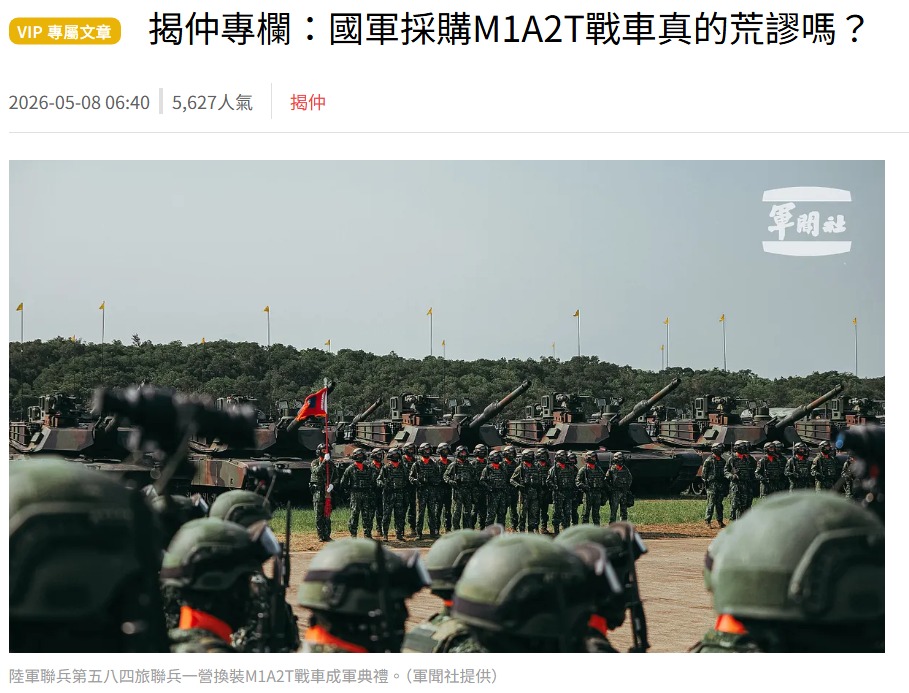
台灣多數橋樑無法通行M1A2T戰車,影響沒有想像中嚴重!只要戰車部隊各級指揮官,甚至各車的車長與駕駛,在承平時期做好戰場經營,切實掌握防區內橋樑與道路的狀況,規劃數條從營區開往戰力保存區,及從戰力保存區進入戰術位置時的機動路線,就可迎刃而解。就算前往戰術位置的機動路線上,真的無合適橋樑可用,或既有橋樑遭破壞,只要事先做好準備,還是能藉良好的計畫作為,運用工程手段或工兵裝備來克服。
在國軍從事的是國土防衛作戰,部隊早就「先處戰地」的情況下,單憑橋樑承重、地形破碎、高耗油甚至不適合城鎮地型等理由,就認定M1A2T戰車無用武之地,確實有「以偏概全」的情形;因為這些顧慮,都可透過平日的戰場經營來化解,絕非「不可承受之重」!
國人也該認清,在現代的戰場條件下,主力戰車雖已不再具備「陸戰霸王」的主宰地位,但因為主力戰車能兼顧火力、機動力與防護力,使其在現代的兵種聯合作戰中,仍將扮演重要的腳色。試問,若僅因為無人機對戰甲車所造成的威脅日益升高,就將戰甲車棄之不用;屆時步兵就必須自己扛著裝備與物資,靠雙腿機動,然後在敵軍的旺盛火力下,僅憑血肉之軀,對敵軍的設防陣地與障礙物發起攻擊,這顯然不切實際。(圖片擷取自風傳媒網頁)


近期迴響